Radon in Spain: An Overhang You Can't Smell
Spain has 838 lung-cancer deaths a year attributable to a gas you cannot see, smell, or taste. The data exists, the regulation exists, the science is settled. The translation layer between institutional knowledge and the person standing in their kitchen does not. This is a map of where the radon overhang sits and what kind of tool is honest to build inside it.
Radon is a radioactive gas that can seep from uranium-bearing rock into buildings. You cannot see it, smell it, or taste it. It is the second leading cause of lung cancer, behind only smoking, and the number one cause among non-smokers.
The useful reference point is 300 becquerels per cubic metre. That is the European and Spanish long-term reference level for indoor radon. Above it, authorities expect some kind of action: measurement, ventilation, building protection, or remediation.
In Villar de la Yegua, a village in the granite borderlands of Salamanca, a 2004 survey of 56 homes found an arithmetic mean indoor radon concentration of 1,851 Bq/m³ — more than six times that reference level. Seventy-one per cent of the homes measured were above 1,000 Bq/m³.
There was no institutional channel to tell them — Spain had not, at that point, built one. There is no Spanish equivalent of the United Kingdom's UKradon postcode lookup. There was no certified mitigator in their province advertising the service. The CSN's national radon map exists, but to read it you need to know what GIS is, and you need to know what radon is in the first place.
The numbers
The landmark Darby et al. (2005) European pooling study established a 16 % increase in lung-cancer risk per 100 Bq/m³ of long-term average indoor radon concentration.
The Ministerio de Sanidad's 2021 mortality report estimated 838 lung-cancer deaths per year attributable to residential radon. That is 3.8 % of Spanish lung-cancer mortality.
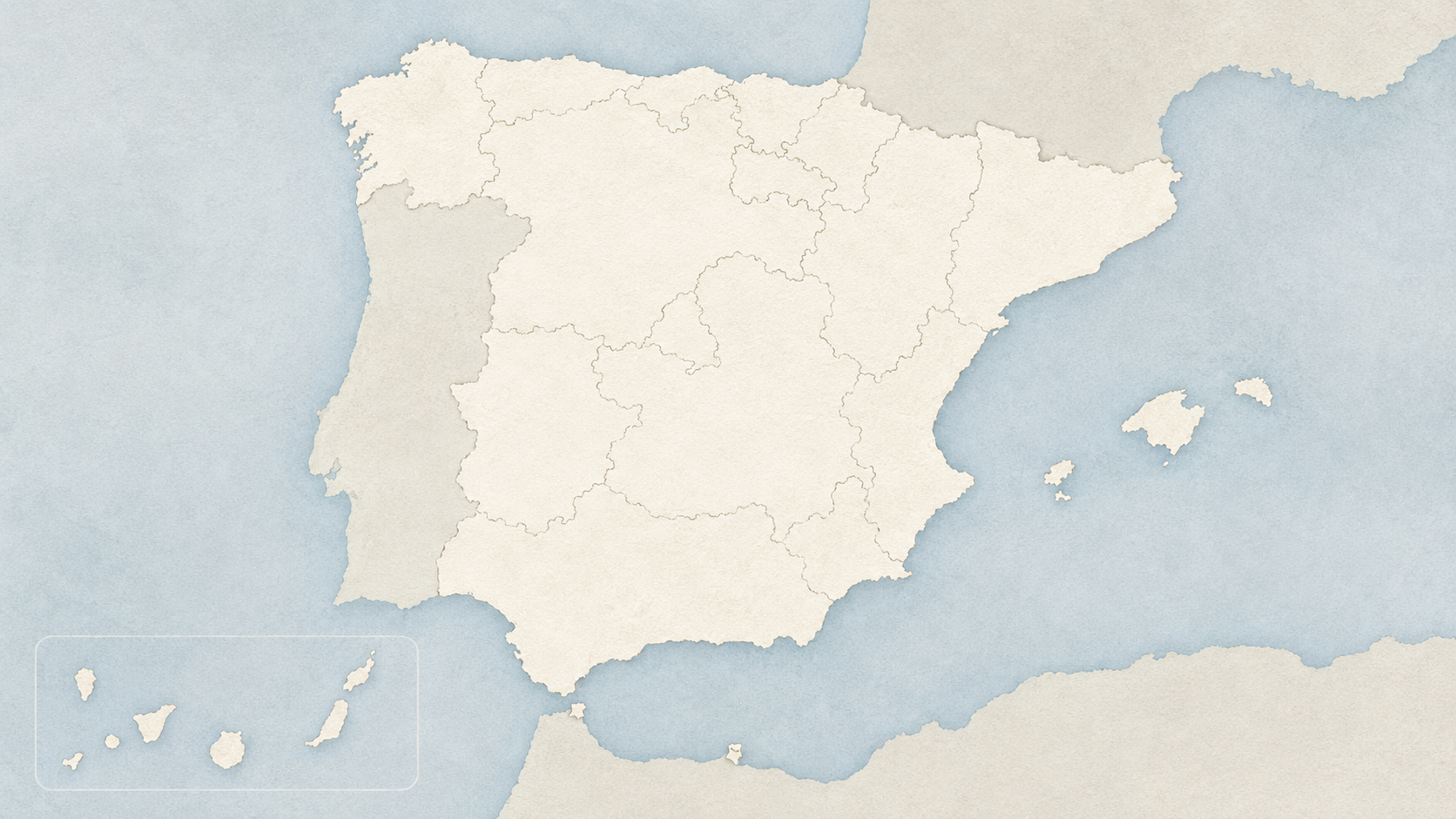
What is actually in place
Spain has the pieces of a radon system. They just do not meet an ordinary person at the point of need.
🏛️Spain's radon framework
- CSN radon potential map — the national public map, built from indoor measurements, gamma-radiation data, and geological mapping, but exposed through a specialist GIS viewer.
- CTE DB-HS6 — the building-code layer: Spain's rules for radon protection in new buildings and major works in priority municipalities.
- Plan Nacional contra el Radón / IS-47 — the public-health and workplace frame: Spain has a national plan, and the CSN has turned the municipality lists into operational detail.
- Laboratorio de Radón de Galicia at USC — the strongest regional example: academic measurement, accreditation, and a Galician map moving toward much finer local granularity.
What it does not contain is the consumer-facing layer that exists in the UK.
The UK's UKradon.org takes a postcode and returns a colour-coded risk classification, links to certified test-kit suppliers, a paid address-specific report (£3.90), and a clear Check → Test → Fix pathway. It is built on 500,000+ dwelling measurements. The Irish EPA radon map allows Eircode-level lookup through a polished GIS viewer. Spain has comparable underlying data quality for its high-risk regions — Galicia in particular is approaching UK-level granularity — but the consumer-accessibility gap is roughly a decade.
To use the CSN's equivalent, you have to know what radon is, what GIS is, where on the national ArcGIS viewer your municipality sits, and what "P90" means. The CSN's own FAQ warns that the map "puede tardar en cargar varios minutos." There is no postcode field. There is no name search.
A handful of private Spanish sites — RadonStop.org, RadonSpain.com, ViveSinRadon.org — offer simple municipality lookups, but they are thin lead-generation wrappers around the published Zone I/II list, designed to funnel users to commercial measurement and mitigation services. No Spanish-language app exists in any app store offering municipal radon risk lookup without a commercial funnel.
The data exists. The translation layer does not.
The action pathway is broken
The practical journey is not mysterious. Nobody has joined the steps.
Mitigation works, but there is no national directory of qualified mitigators and no national residential certification equivalent to the UK or US systems.
A high result is bad news, but it is not a verdict on the house: the usual pathway is measure, mitigate, and measure again. What the mitigate step actually contains is small and well-understood. The standard family of interventions is three things: sub-slab depressurisation — a small fan that draws radon out from beneath the building before it can enter; ventilation — increasing or balancing airflow in the lower floors so any radon that does enter is diluted; and sealing the obvious entry routes — cracks, service penetrations, ground-floor joints — so there are fewer of them in the first place. None of these are exotic. They are the same techniques used across every European radon programme, scaled to a single home, and documented for Spanish conditions through CSIC's Proyecto Radoncero case studies. The bottleneck is not the engineering. It is finding a qualified installer who knows the techniques and a measurement protocol that confirms they worked.
So the intervention is not a miracle product. It is a clearer first step.
The tool
The companion tool is live at radon.willworth.es.
It is a static, bilingual, Spanish-first municipality lookup. It combines the CTE DB-HS6 Appendix B classifications with the INE national municipality base, and lets a user search any of Spain's roughly 8,100 municipalities and see whether the current data overlay places it in Zone I, Zone II, not classified, or pending validation. It also points people toward the next question: whether to measure, and how to think about the result.
One disclosure belongs in the body of this piece, not in a footnote: Salamanca — the province of the opening example — is currently one of the provinces whose classifications the tool withholds as pending validation, because the extracted data there did not survive the tool's own checks. The gap this piece maps runs through its own flagship example.
What it isn't:
- It does not replace measurement.
- It does not make address-level claims.
- It does not treat absence from a classification list as proof of no risk.
- It does not sell testing, mitigation, or a paid certificate.
A better lookup is still downstream of awareness. It only helps once somebody has heard enough about radon to search for it, and it cannot solve the contractor, certification, and policy gaps waiting after the result.
But for the person who has just heard the word radon, or has found their town on a difficult official map and does not know what to do with that information, a clearer first step is not nothing. It is the part that can now be built cheaply and honestly: take public data, show its boundaries, and refuse to turn uncertainty into reassurance.
The real test of this project is not traffic, or whether the lookup is clever. It is whether the information completes the journey at least once: somebody hears about radon, checks their municipality, orders a proper home measurement, understands the result, and, if necessary, finds a credible route to mitigation and re-testing.
That is also why I plan to treat publication as the start of the experiment, not the end of it. After publishing this, I want to put it in front of regional newspapers, public-health people, radon researchers, and local routes where it might actually reach households. The question is whether a small public-information tool can move even one person from vague risk to measured reality.
Resources
🇪🇸Spanish data and regulation
- CSN radon potential map: https://www.csn.es/mapa-del-potencial-de-radon-en-espana
- CSN municipality zonification map: https://www.csn.es/mapa-de-zonificacion-por-municipio
- BOE — Real Decreto 732/2019 (CTE DB-HS6): https://www.boe.es/diario_boe/txt.php?id=BOE-A-2019-18528
- BOE — IS-47 CSN instruction: https://www.boe.es/diario_boe/txt.php?id=BOE-A-2025-8734
- Plan Nacional contra el Radón (PDF): https://www.sanidad.gob.es/areas/sanidadAmbiental/riesgosAmbientales/radon/publicaciones/docs/Plan_Nacional_contra_el_Radon.pdf
- Ministerio de Sanidad mortality report (2021): https://www.sanidad.gob.es/ciudadanos/saludAmbLaboral/docs/04_Mortalidad_radon.pdf
- CTE DB-HS6 official guide: https://www.codigotecnico.org/pdf/GuiasyOtros/Conceptos_basicos_RD_732_2019_DBHS_6.pdf
🧪Science and epidemiology
- WHO fact sheet on radon and health: https://www.who.int/news-room/fact-sheets/detail/radon-and-health
- Darby et al. (2005), BMJ — European pooling study: https://pmc.ncbi.nlm.nih.gov/articles/PMC546066/
- Ruano-Raviña et al. (2021), Environmental Research: https://www.sciencedirect.com/science/article/pii/S0013935121006666
- Pérez-Ríos et al. (2010), BMC Public Health: https://pmc.ncbi.nlm.nih.gov/articles/PMC2885334/
- Martin-Gisbert et al. (2025), Indoor Air — Galicia map: https://onlinelibrary.wiley.com/doi/full/10.1155/ina/4176561
- CSIC Proyecto Radoncero (mitigation case studies): https://proyectoradoncero.ietcc.csic.es/
🏛️Regional and academic infrastructure
- Laboratorio de Radón de Galicia (USC): https://radon.gal/es/
- Galicia radon strategy (SERGAS): https://airesaude.sergas.gal/Contidos/CAI_Radon?idioma=es
- ENAC accreditation of LARUC: https://www.enac.es/actualidad/laruc-radon-calibracion
- Junta de Extremadura — radon guides: https://www.juntaex.es/w/publicacion-gas_radon
- Extremadura — Reduce Radón Laboral plan: https://www.juntaex.es/w/plan-de-actuacion-frente-al-radon
🌐Comparison: UK and Ireland
- UKradon.org — postcode-level lookup, paid address reports: https://www.ukradon.org/
- Ireland EPA radon map: https://www.epa.ie/environment-and-you/radon/radon-map/
- Ireland EPA interactive GIS map: https://gis.epa.ie/EPAMaps/Radon
🔗Existing Spanish private sites
- RadonStop.org (basic municipality lookup): https://radonstop.org
- RadonSpain.com (basic municipality lookup): https://radonspain.com
- ViveSinRadon.org (information and congress): https://vivesinradon.org
This is part of the Avenues of Investigation series — mapping technological overhangs where motivated individuals might find leverage. The companion methodology piece is When Building Becomes Cheap, Responsibility Moves Upstream. The companion tool is at radon.willworth.es.